Client: Studentsamskipnaden i Oslo (SIO)
Partners: Anlegg Øst (on-site execution) + Steer (remote control, operations, cameras, connectivity)
Location: Carl Berner, Oslo — Hasleveien / Sukkertoppveien
Status: Completed (rapid-response phase)
Project period: Late November 2025 (response and initial stabilization)
.jpg)
On Sunday 26 October 2025, a rock and soil slide occurred in a steep cut between residential buildings and SiO’s Carl Berner student housing (Hasleveien 9–11). The incident led to the evacuation of hundreds of residents and the establishment of an evacuation center at Radisson Blu Alna.
Early assessments indicated ongoing instability and the risk of additional rockfall, which meant essential stabilization work needed to start quickly—while keeping people out of the danger zone. Police updates note that NGI assessed parts of the area as safe to re-enter, while other areas remained restricted pending further investigation.
Steer received a request to mobilize shortly after the slide began. Together with Anlegg Øst Entreprenør, a rapid plan was executed to stabilize the slope and protect nearby buildings—using remote-controlled excavators to reduce exposure and enable controlled work close to the hazard.
Media coverage highlighted that the cut is geologically complex, with numerous fractures and weak zones. A University of Oslo geology professor described the rockface as consisting of ~454 million-year-old seabed sediments and ash layers, and noted that the cut is not natural—its geometry and weaknesses were exposed by excavation, creating a surface with many potential failure planes.
In practice, this meant:
repeated small movements were possible after the initial event,
scaling and stabilization had to be executed conservatively, and
work near the slope required minimizing personnel exposure.
.jpg)
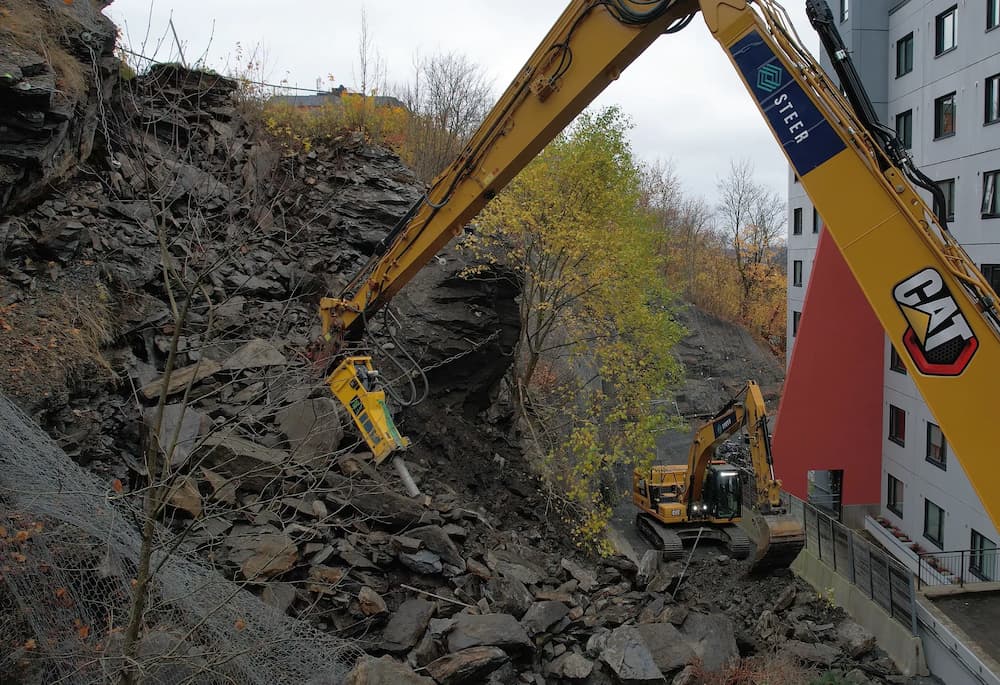
The response plan focused on life safety, property protection, and fast restoration of safe living conditions for affected residents and students. Key tasks included:
Rapid hazard assessment and coordination with Norges Geotekniske Institutt (NGI) and authorities (including data collection and surveys where relevant)
Rapid hazard assessment and coordination with Norges Geotekniske Institutt (NGI) and authorities (including data collection and surveys where relevant)
Controlled reduction of unstable material (“scaling”) using remotely operated excavators
Removal and haulage of loosened rock/soil
Final stabilization measures including shotcrete and anchoring/bolting, consistent with public updates that the ongoing works included shotcrete application and installation of additional anchors
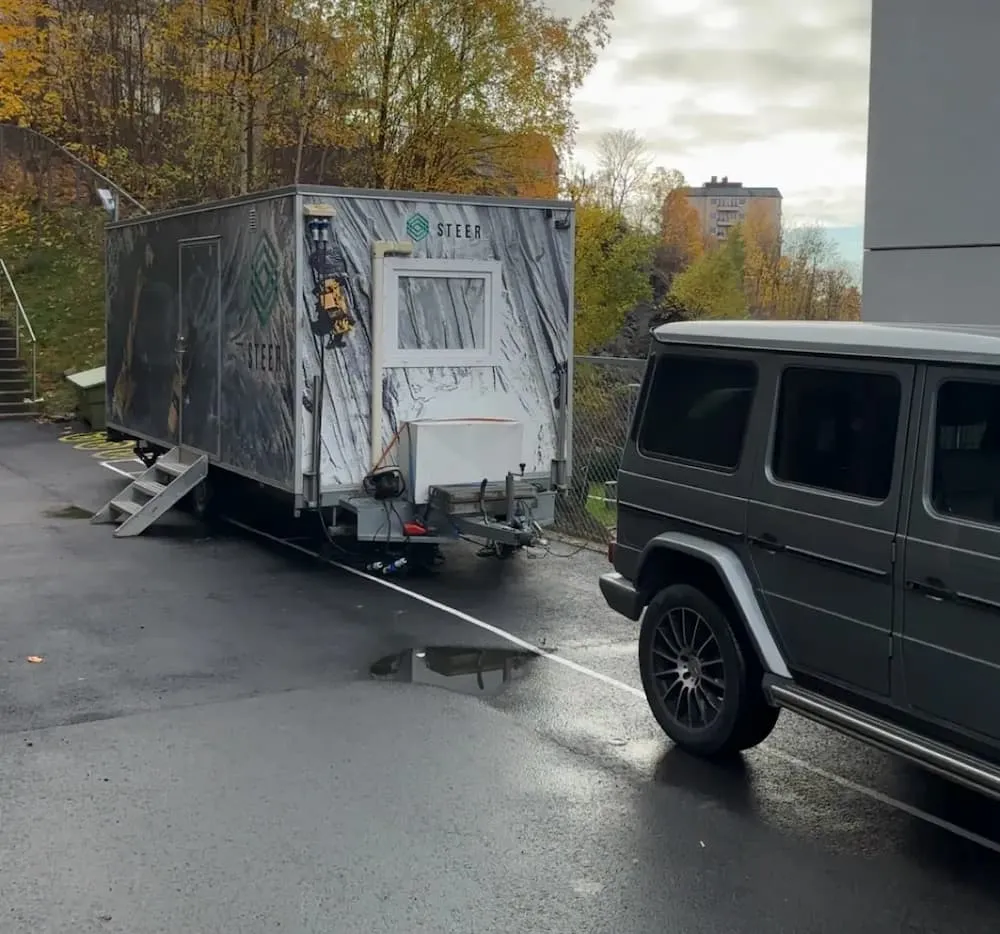
To keep people out of the hazard zone while still enabling high-precision work, Steer deployed:
Mobile operations center
PTZ cameras for situational awareness (workface + perimeter)
Secure Wi-Fi network supporting control signals and video transport
Police updates explicitly reference NGI involvement on-site and controlled, limited access for residents to retrieve essentials under supervision—illustrating how tightly access and safety had to be managed while technical work progressed.
To keep people out of the hazard zone while still enabling high-precision work, Steer deployed:
CAT 323 — prepared for remote-controlled work (rapid deployment)
CAT 340 Long Reach with breaker (hammer) — rental machine converted for remote operation on delivery day by Steer
This two-machine setup enabled both heavy scaling (Long Reach + breaker) and controlled cleanup/loading (CAT 323), while maintaining operational safety through remote control.
Day 0 (event day):
Slide occurs; evacuations initiated; access control established; early geotechnical involvement begins.
Day 1–2 (mobilization + setup):
Steer + Anlegg Øst mobilize within 48 hours
Operations center established; PTZ cameras and secure Wi-Fi installed
Steer + Anlegg Øst mobilize within 48 hours
Steer + Anlegg Øst mobilize within 48 hours
Day 3 (start of heavy scaling):
Controlled hammering (breaker) begins to reduce unstable rock masses (Steer project data)
Within ~24 hours of hammering start:
Main unstable rock masses are broken down; slope is cleaned, scaled, and secured via remote control using CAT 340 + CAT 323 (Steer project data)
Follow-on stabilization:
Debris loaded and hauled away
Shotcrete applied; rock anchored/bolted
.webp)
Carl Berner demonstrated the value of remote-controlled construction equipment in urban hazard response:
Reduced exposure: Remote operation kept operators away from unstable terrain while enabling work close to the hazard.
Fast turnaround: Rapid mobilization and same-day remote retrofitting meant production could start quickly even with a rental machine.
Controlled stabilization: Long Reach hammering plus precise cleanup/loading enabled a structured progression from hazard reduction to full securing.
Community impact: With securing measures in place and NGI’s evaluations completed, students were able to return within a week, restoring a critical residential facility quickly.


