Client: Boliden (Renströmsgruvan, Skellefteå)
Location: Renström underground mine, Västerbotten, Sweden
Status: Delivered and in operation
Machine: Volvo L90 wheel loader
Renströmsgruvan is part of Boliden’s mining operations in the Skellefteå area in northern Sweden—an established mining district built around underground production and complex ore bodies. In the Boliden Area, mines like Renström produce polymetallic sulphide ores associated with zinc, copper, lead, gold, and silver.
In underground production, the hours immediately after blasting are operationally critical—but they are also the hours when people often cannot be present. The mine must be ventilated and cleared before human access is restored. For this project, Steer delivered a remote-controlled Volvo L90 (2022) so the site can perform road maintenance during the ventilation / no-entry period, enabling normal production to start immediately once the mine is cleared for personnel.
The value in this use case is timing.
After blasting, crews and equipment are often waiting for ventilation and clearance. By moving road maintenance into that window—when people cannot be underground anyway—the operation can return to production without first spending additional time on “catch-up” maintenance.
For the mine, the result is straightforward:
production can resume faster after clearance
the first post-clearance shift starts with infrastructure already prepared
exposure risk is reduced by keeping operators out of the mine during the restricted period
.webp)
.webp)
Steer’s delivery covered a complete teleoperation setup for underground road maintenance, including:
Remote control of driving and implement functions required for maintenance passes
Integration to the machine’s data layer to provide vehicle status and operator feedback
A high-resolution video setup designed for long tunnel work
An operator station built for precision, comfort, and repeatable performance
Implementation with compliance and documentation in mind, aligned with CE and Machinery Directive requirements for modified machinery solutions
The wheel loader’s high-resolution video streams are transported over the mine’s existing MOXA Wi-Fi network. In this deployment, the end-to-end video/control experience is designed around ~0.1 s latency (site-measured) and seamless roaming between access points as the loader moves through kilometer-long underground tunnels.
MOXA’s industrial Wi-Fi portfolio is explicitly built to support fast handovers (“roaming”) for moving industrial clients, helping maintain uninterrupted connectivity across multi-access-point deployments.
The remote driving experience depends on consistent visual clarity and stable handovers—not just peak bandwidth. The network and camera configuration were built around the reality of underground geometry: long lines of travel, repeating intersections, and varying lighting conditions.
Volvo supplied a CAN gateway to the project, allowing Steer to connect into the machine’s data layer. This makes it possible to expose relevant vehicle data inside the Steer Remote interface, supporting both operator awareness and system-level safeguards.
The Volvo L90 platform in this configuration includes a combination of electrically controlled and hydraulically actuated functions. To achieve full remote functionality, the solution includes:
a custom wiring harness from Steer
electro-hydraulic valves installed on the machine where required
integration of both command and feedback signals into the remote-control stack
The outcome is consistent control behaviour for the operator—regardless of whether a given function is electric or hydraulic at the machine level.
.webp)
.webp)
The following functions and data are available through the Steer Remote solution for this loader:
Lift
Tilt
3rd function
4th function
Throttle
Gear selection
Parking brake / handbrake
Service brake
Selected vehicle data (status and operational signals)
The following functions and data are available through the Steer Remote solution for this loader:
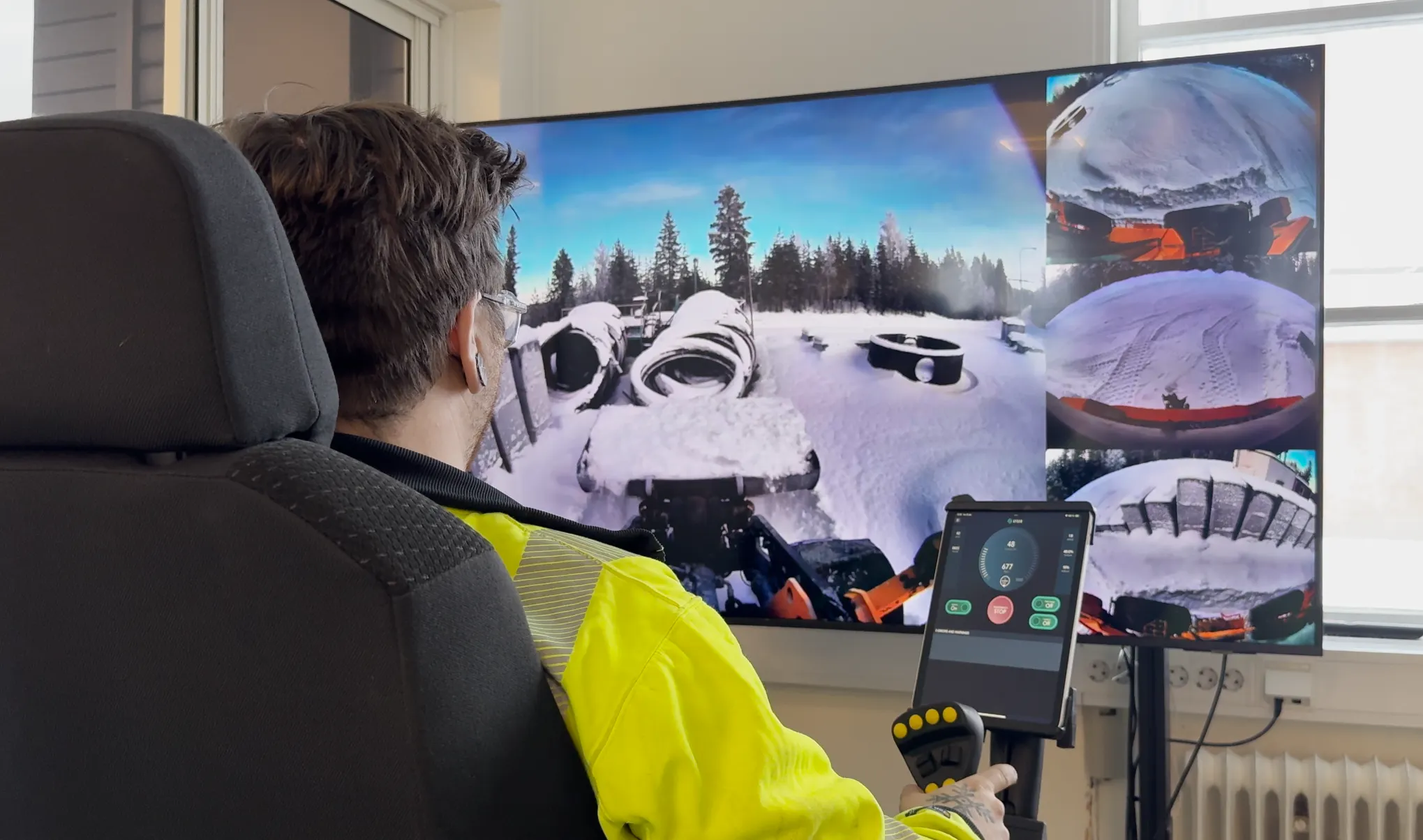
The operator station is purpose-built for long-duration, high-attention teleoperation:
Operator chair
Joysticks
Pedals
Touchscreen (system interaction and configuration)
65" main display for the live video feed
Sound system
This setup is designed to reduce fatigue and improve precision over long tunnel distances—especially important when the vehicle is moving through repetitive environments where small mistakes compound over time.
The Volvo L90 is a mid-size wheel loader class used broadly for material handling and maintenance tasks. In this project, the platform was selected for its suitability as a dedicated underground road maintenance tool in the post-blast window.
Remote operation underground must be treated as a complete system—machine, control layer, communications, human factors, and safety functions working together.
In this delivery, Machinery Directive and CE considerations were addressed as part of the solution, including the principles that apply to machinery placed on the market and modified machinery solutions within the EEA.
.webp)
This project demonstrates a highly practical pattern for underground mines:
Use teleoperation to shift necessary work into time windows when people cannot be underground
Keep the restart path clean: once the mine is cleared, production can begin immediately
Build the remote experience around three realities that decide success underground: stable roaming, low latency, and operator clarity
For Boliden at Renström, the remote-controlled Volvo L90 becomes a tool for improving production readiness—by doing the right work at the only time it can be done without delaying the next phase.


